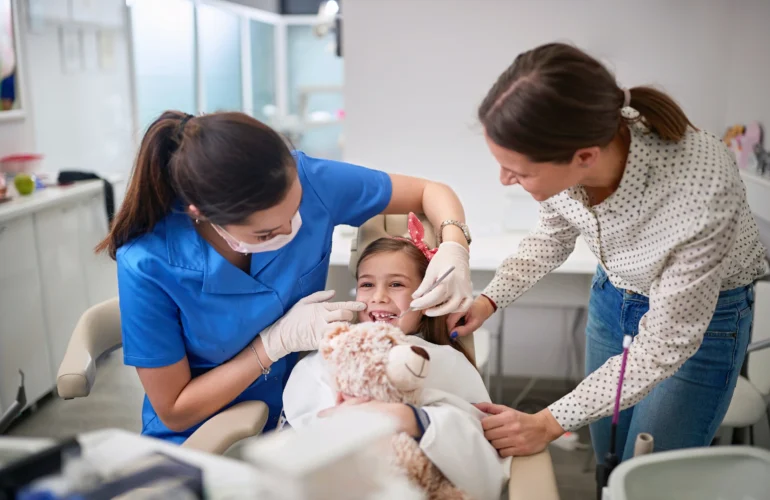
“Didn’t they already do fluoride? Why does she need sealants too?”
It’s a fair question, and a common one for any kids dentist in Modesto. Both treatments are quick, painless and aimed at preventing cavities, so it’s easy to assume they do the same thing. They don’t. Fluoride varnish and dental sealants each protect a different part of the tooth, in a different way, and they tend to come into a child’s life at different ages.
This guide explains how each one works, when children usually get them, what the research says about safety, and why most kids benefit from having both.
Two Treatments, Two Different Jobs
The simplest way to think about it: fluoride strengthens the whole tooth, and sealants guard the spots that are hardest to keep clean.
What Fluoride Varnish Does
Fluoride varnish is a thin, sticky coating painted onto the teeth with a small brush. It stays on the enamel for several hours, releasing fluoride as it sits there.
Fluoride helps in a few ways:
- It makes enamel more resistant to acids from cavity-causing bacteria.
- It helps repair very early weak spots (chalky white areas).
- It protects every surface it touches, including between teeth.
Because it covers the whole tooth, varnish is useful from the very first tooth onward. The U.S. Preventive Services Task Force recommends fluoride varnish for infants and young children starting when their baby teeth come in. Our fluoride application for kids takes only a couple of minutes during a regular visit.
What Dental Sealants Do
The chewing surfaces of back molars aren’t flat. They’re covered in deep, narrow grooves (dentists call them pits and fissures), and many of those grooves are thinner than a single toothbrush bristle. Food and bacteria settle in, and even a careful brusher can’t fully reach them.
A sealant is a thin, tooth-colored coating that flows into those grooves and hardens, turning a deep crevice into a smooth surface that’s much easier to keep clean.
According to the CDC, about 9 in 10 cavities in school-age children happen in the back permanent teeth, and sealants applied soon after those molars come in can prevent up to 80% of cavities for two years and about half for up to four years. Learn more about how we place dental sealants for kids.
Sealants vs. Fluoride at a Glance
Here’s a quick side-by-side comparison:
- What it protects. Fluoride varnish strengthens all tooth surfaces. Sealants protect the chewing grooves of molars.
- How it works. Fluoride works chemically by hardening enamel. Sealants work physically by blocking the grooves.
- When it starts. Fluoride can begin with the first baby tooth. Sealants usually start once the permanent molars come in.
- How often. Fluoride varnish is typically repeated at regular checkups, often every three to six months depending on your child’s cavity risk. Sealants are applied once and checked at each visit, with touch-ups if needed.
- What the visit feels like. Both are painless, with no drilling and no numbing. Varnish takes a minute or two. Sealants take a few minutes per tooth: clean, prepare, paint into the grooves, then harden with a special light.
When Do Kids Usually Get Each One?
Fluoride: From the First Tooth
Fluoride protection can start in babyhood. At your child’s first dental visit, which is recommended by the first birthday or within six months of the first tooth, we look at how the teeth are developing and talk about brushing, feeding and fluoride. Our infant oral care visits are designed for exactly this stage.
Sealants: Timed to the Molars
Sealants work best when they’re placed soon after a molar fully comes in, before decay has a chance to start in the grooves. For most children, that means two windows:
- First permanent molars: usually around age 6. These come in behind the baby teeth, without a baby tooth falling out first, so parents often don’t notice them.
- Second permanent molars: usually around age 12.
These ages are a guide, not a rule, and every child is a little different.
Are Sealants and Fluoride Safe? Answers to Common Concerns
Parents are right to ask questions about anything that goes on their child’s teeth. Here’s what the current evidence says.
The BPA Question With Sealants
Some parents have read that dental sealants contain BPA (bisphenol A). The American Dental Association explains that BPA is not an ingredient in dental sealants. Very small traces can be present as a byproduct of the materials, and a tiny amount may be released for a few hours right after placement.
That amount is extremely small. The ADA estimates it’s far less than what people encounter from everyday sources like air or handling paper receipts, and it reports no evidence of harm to patients from sealants. Rinsing the teeth after placement reduces trace amounts even further.
How Much Fluoride Is in Varnish?
Varnish is applied in a very thin layer using only a small amount, and because it sets quickly, very little is swallowed. The bigger fluoride question at home is usually toothpaste:
- Under age 3: a smear of fluoride toothpaste about the size of a grain of rice.
- Ages 3 to 6: a pea-sized amount.
- Always supervise so your child spits out the extra rather than swallowing it.
If your child takes prescribed fluoride supplements, let us know.
Why Sealants and Fluoride Work Best Together
Fluoride strengthens enamel everywhere, including the smooth surfaces and the tight spaces between teeth, where sealants don’t reach. Sealants close off the deep grooves on chewing surfaces, where fluoride alone has a harder time keeping up. Research reviewed by the ADA found that for those chewing surfaces specifically, sealants prevented more cavities than fluoride varnish on its own. That doesn’t make fluoride less important. It simply means each treatment is strongest at its own job.
Neither treatment replaces good habits at home. Brushing twice a day, flossing once teeth touch, limiting sugary sips and keeping regular checkups all still matter.
If your child has already had a cavity, prevention becomes even more valuable. Our post on why baby teeth cavities matter explains how decay is treated and why stopping it early makes such a difference.
Preventive Care at Family and Kids Dental
Family and Kids Dental is located at 1207 14th St in Modesto, and we care for children and adults under one roof. Dr. Syed Hyder, DDS, is a general dentist who has spent 10 years focused on gentle care for families, with a particular emphasis on children. Each step is explained to your child in simple words, and parents stay informed throughout. You can read more about Dr. Syed Hyder.
We welcome families from Modesto, Ceres, Turlock, Riverbank, Oakdale, Salida, Empire and Keyes. We accept Medi-Cal and most major dental insurance plans, offer payment plans, and serve both English and Spanish-speaking families. To see everything we offer for younger patients, visit our Kids Dentist in Modesto page.
Frequently Asked Questions
Does my child need sealants if they already get fluoride?
In many cases, yes. Fluoride strengthens the enamel on every surface, but the deep grooves on the chewing surfaces of molars are narrow enough that food and bacteria can stay trapped there even with good brushing and regular fluoride. Sealants physically close those grooves. Because the two treatments protect different areas in different ways, many dentists recommend both. Your child’s dentist will look at their teeth, their cavity history and their habits before making a recommendation.
How long do dental sealants last?
Sealants can last for several years, and many hold up well through the teenage years. They can wear down or chip over time, especially with hard or sticky foods, so they’re checked at each regular visit. If part of a sealant has worn away, it can usually be repaired or reapplied quickly and painlessly. Keeping up with checkups is the best way to make sure the protection stays in place.
Is fluoride varnish safe for toddlers?
Fluoride varnish is widely recommended for young children, including babies once their first teeth come in. Only a small amount is used, it’s painted on in a thin layer, and it sets quickly, so very little is swallowed. Most toddlers tolerate it easily because it takes about a minute. If you have specific questions about your child’s fluoride intake, including toothpaste or supplements, bring them up at the visit and we’ll give advice based on your child.
Can sealants be placed on baby teeth?
Sometimes. Sealants are most often placed on permanent molars, but baby molars with deep grooves, or teeth in children with a higher risk of cavities, may also benefit. Baby molars stay in the mouth until around age 10 to 12, so protecting them can be worthwhile. Whether sealants make sense for your child’s baby teeth depends on the shape of the teeth and their overall cavity risk, which your dentist can assess.
Can a sealant go over a tooth that already has a small cavity?
In some cases, a sealant can be placed over a very early weak spot that hasn’t broken through the enamel, and research suggests this can help slow it down. A tooth with an actual cavity usually needs to be treated first, often with a small filling. That’s one reason sealants are placed after a careful exam. Getting them on soon after the molars come in gives the best chance of preventing decay in the first place.
Does Medi-Cal cover sealants and fluoride for kids?
Medi-Cal Dental generally covers preventive care for children, which typically includes fluoride treatments and sealants on eligible teeth. Coverage rules can depend on your child’s age, which teeth are being treated and how often the service has been done, so it’s best to confirm the details for your child. Family and Kids Dental accepts Medi-Cal and most major dental insurance plans, and our team is happy to help you check what’s covered before the visit.
Book a Prevention Visit With a Kids Dentist in Modesto
If your child is around 6 or 12, or it’s been more than six months since their last checkup, it’s a great time to ask about sealants and fluoride. A few minutes of prevention now can spare your child a filling later.
Family and Kids Dental
1207 14th St, Modesto, CA 95354
Phone: (209) 422-3176
Schedule an appointment online or call our office, and our team will help you find a time that works for your family.