Family Dentist

Family Dental Care at Every Age: What a Family Dentist in Modesto Watches For, From Toddlers to Grandparents

A toddler’s first checkup and a grandparent’s denture adjustment look like two very different appointments. In a family practice, they often happen on the same afternoon, sometimes for people who share a last name and a kitchen table.

As a family dentist in Modesto, we see how a mouth changes over a lifetime. What matters at age two is not what matters at sixteen, during a pregnancy or at seventy-five. This guide covers what we look for at each stage, what to watch for at home, and why keeping everyone’s records in one place helps.

Babies and Toddlers (Birth to Age 3): Setting the Foundation

The first tooth usually shows up somewhere around six months, though anywhere from four to fifteen months can be normal. Current guidance from children’s dental organizations is to schedule a first dental visit by the first birthday, or within six months of that first tooth.

At this age, a visit is short and gentle, often with the child in a parent’s lap. We check how teeth are coming in, look for early white spots and talk about feeding and cleaning habits. Our infant oral care visits are built around this stage.

What to watch for at home:

  • Chalky white lines along the gumline of the upper front teeth, often the first sign of early decay.
  • Bottles or sippy cups at bedtime filled with milk, formula or juice.
  • Toothpaste amount. Use a smear of fluoride toothpaste about the size of a grain of rice until age three.
  • Long-term pacifier or thumb habits, which are worth mentioning at checkups as your child gets older.

School-Age Kids (Ages 4 to 12): Busy Mouths, Changing Teeth

Baby teeth fall out and permanent teeth arrive during these years. The first permanent molars come in around age six, behind the baby teeth, and many parents never notice them.

At this stage we focus on:

  1. Cavity prevention. From age three, use a pea-sized amount of fluoride toothpaste. Most kids need a parent’s help brushing until around age seven or eight.
  2. Sealants and fluoride. Thin protective coatings on the chewing surfaces of new molars help block the deep grooves where many childhood cavities start.
  3. Spacing and bite. Orthodontic specialists suggest a bite check around age seven. That doesn’t mean braces at seven, just an early look for crowding.
  4. Sports safety. A mouthguard protects new front teeth during contact sports.

For more on how we care for children, our kids dentist in Modesto page covers it.

Teenagers (Ages 13 to 19): Independence Has Its Risks

Teens take over their own brushing just as schedules get packed. Checkups slip, energy drinks show up, and cavities can appear in permanent teeth that were healthy a few years earlier.

Things we keep an eye on for teens:

  • Orthodontic needs. Many teens are good candidates for braces or clear aligners, and brushing carefully around brackets matters during treatment.
  • Wisdom teeth. We monitor their position over time, since not everyone needs them removed.
  • Vaping and tobacco. Both are linked to gum irritation and dry mouth. We bring this up without lectures.
  • Acid wear. Frequent soda and sports drinks can soften enamel.

Adults (Ages 20 to 60): Protecting What You’ve Got

For adults, the two biggest concerns are gum disease and wear and tear.

Gum disease is common. The CDC estimates that roughly four in ten adults age 30 and older have some form of periodontitis, and it often doesn’t hurt in the early stages. Bleeding when you brush or floss is a common early sign, and it isn’t normal.

Adults should also watch for:

  1. Grinding or clenching. Signs include morning jaw soreness and flattened or chipped teeth.
  2. Worn or cracked fillings. When too much of a tooth is weakened, an adult dental crown can protect what’s left.
  3. Sensitivity to hot or cold, which can point to receding gums, a cracked tooth or decay.
  4. Changes that don’t heal, such as a sore, patch or lump in the mouth lasting more than two weeks. Oral cancer screening is typically part of a routine exam.

How often you need checkups depends on your health and history. Learn what’s included in a routine dental exam and emergency care.

During Pregnancy: Safe Care and Sensitive Gums

Many expectant mothers put off the dentist, but major dental and obstetric organizations agree that routine dental care, including cleanings, needed X-rays and local anesthetic for fillings, is safe during pregnancy. Postponing necessary treatment can be riskier than having it.

Hormone changes can make gums swell and bleed (pregnancy gingivitis), and morning sickness exposes teeth to stomach acid. A few habits help:

  • Rinse with water (or water mixed with a little baking soda) after vomiting, and wait a bit before brushing.
  • Keep brushing twice a day with fluoride toothpaste, even if your gums feel tender.
  • Tell us you’re pregnant, and how far along, when you book.

There’s a family benefit too. Cavity-causing bacteria can pass from parent to baby through shared spoons, so a healthy mouth before baby arrives helps the whole household.

Older Adults (60 and Up): Dry Mouth, Roots and Gums

Teeth can last a lifetime, but the later years bring quieter challenges.

Dry mouth from medications. Hundreds of common medications, including some for blood pressure, depression and allergies, can reduce saliva. Less saliva means more cavities. Sipping water, chewing sugar-free gum and telling us every medication you take all help.

Root decay. As gums recede, the roots of teeth become exposed. Roots lack hard enamel, so they decay more easily, and extra fluoride may help.

Gum disease. It is a leading reason adults lose teeth. If arthritis makes brushing hard, an electric toothbrush often helps.

Dentures and missing teeth. If teeth have been lost, partial and complete dentures can restore chewing and confidence. They should be checked regularly as the gums underneath change.

Why One Family Dentist in Modesto Keeps the Picture Clear

When the whole family sees the same dentist, records stay continuous, and that has real value:

  • Patterns show up. If a parent has a history of gum disease or deep grooves in their molars, we know to watch for the same in their kids.
  • X-rays can be compared over the years, so small changes stand out instead of being guessed at.
  • Medication and health changes are noted in one place, which matters a lot for older adults and during pregnancy.

About Family and Kids Dental

Family and Kids Dental, at 1207 14th St in Modesto, treats kids and adults under one roof. Dr. Syed Hyder, DDS, is a general dentist with 10 years of experience focused on gentle care for whole families, with particular attention to children. For kids who need extra help relaxing, nitrous oxide conscious sedation is available when appropriate, and it’s always discussed with parents first.

We welcome families from Modesto, Ceres, Turlock, Riverbank, Oakdale, Salida, Empire and Keyes. We accept Medi-Cal and most major dental insurance plans, offer payment plans, and our team serves both English and Spanish-speaking families. To see everything we offer for every age, visit our family dentist in Modesto homepage.

Frequently Asked Questions

Can my child and I be seen on the same day?
Many families like back-to-back appointments so parents and kids are seen in one trip. Younger children often feel more comfortable after watching a parent sit in the chair first. Availability depends on the schedule and the type of visit each person needs, so the easiest approach is to call our office, let us know who needs to be seen and what for, and our team will look for times that work together.

Is it really safe to get dental X-rays while pregnant?
Yes, when they’re needed. Leading dental and obstetric organizations consider dental X-rays safe during pregnancy. They use very low radiation aimed at the mouth, not the abdomen. Non-urgent X-rays can sometimes be timed differently, but X-rays needed to diagnose pain or infection shouldn’t be delayed. Always let us know you’re pregnant so we can plan care with that in mind.

My medications give me dry mouth. What can I do?
Tell your dentist and doctor exactly what you take, including over-the-counter products. Sip water through the day, limit caffeine and alcohol, and try sugar-free gum or lozenges. A bedroom humidifier can help too. Your dentist may recommend a higher-fluoride toothpaste or professional fluoride to protect against root decay. Don’t stop a prescribed medication without talking to your doctor first.

When should my teen start thinking about braces?
A bite check around age seven helps spot problems early, but most full orthodontic treatment starts once most permanent teeth are in, often between ages 10 and 14. Every case is different. Some teens benefit from braces, others from clear aligners, and some need no treatment at all. At routine checkups we watch how teeth and jaws are developing and let you know when an orthodontic evaluation makes sense.

Do older adults with dentures still need checkups?
Yes. Even without natural teeth, the gums, tongue and jaw still need examining, including oral cancer screening. Dentures also loosen as the bone underneath changes shape. A poor fit can cause sore spots, trouble chewing and infections at the corners of the mouth. Regular visits let us check the fit, adjust or reline dentures when needed, and catch problems early.

Does Medi-Cal cover dental care for adults as well as kids?
Medi-Cal Dental currently offers benefits for both children and adults, but covered services depend on age and eligibility, and program rules change. The state has announced that starting July 1, 2027, some adults will be limited to emergency dental services, while children under 19 and pregnant or postpartum members keep full dental benefits. Because details vary, please call our office with each family member’s information. We accept Medi-Cal and most major dental insurance plans, and we’ll help you understand what’s covered before treatment begins.

Book Care for the Whole Family

From a baby’s first checkup to a grandparent’s denture fitting, one office can follow your family’s smiles year to year. If anyone in your household is overdue, a family dentist in Modesto who already knows your history is a good place to start.

Family and Kids Dental
1207 14th St, Modesto, CA 95354
Phone: (209) 422-3176

Schedule an appointment online or call our office, and our team will help you find times that work for your family.
Family Dentist

Using Medi-Cal Dental as a Family in Modesto: A Practical 2026 Guide

A lot of local families have Medi-Cal Dental and barely use it. Sometimes it’s because nobody explained what it covers. Sometimes it’s the news, which has been full of talk about cuts and changes, and parents aren’t sure whether their benefits still work. As a family dentist in Modesto that accepts Medi-Cal, these are questions worth answering clearly.

Here’s the short version: for most families, Medi-Cal Dental is still a solid benefit, and children’s coverage is especially strong. This guide walks through how to use it for everyone in your household, from your toddler to your grandparents, and what’s worth knowing about the changes being discussed for 2027.

What Medi-Cal Dental Covers in 2026

Medi-Cal Dental is California’s dental program for Medi-Cal members. The Department of Health Care Services (DHCS) lists a broad range of covered services, including:

  • Exams and x-rays
  • Cleanings
  • Fluoride treatments
  • Fillings
  • Root canals and crowns (when they meet program criteria)
  • Scaling and root planing (a deeper cleaning for gum disease)
  • Extractions
  • Complete and partial dentures
  • Emergency services for pain and infection
  • Orthodontics for children who qualify

Every service has its own rules. Some have frequency limits, some need approval before treatment, and some depend on age. So ask the dental office to check your coverage before a treatment plan starts.

Coverage for Kids vs. Adults

This is where many families get confused, because children and adults don’t have identical benefits.

Medi-Cal Dental for Kids

Children enrolled in Medi-Cal have some of the most complete dental coverage available anywhere. Under a federal rule called EPSDT (Early and Periodic Screening, Diagnostic and Treatment), members under 21 are entitled to dental care that’s medically necessary, not just basic checkups.

In practical terms, that usually means kids can get:

  1. Regular exams, cleanings and fluoride application for kids
  2. Sealants on back molars to help prevent cavities
  3. Fillings, pulpotomies and crowns for baby and permanent teeth
  4. Space maintainers if a baby tooth is lost too early
  5. Orthodontic evaluation, with braces covered for children who meet the program’s criteria

If you’d like to see how we care for younger patients, our kids dentist in Modesto page explains our approach.

Medi-Cal Dental for Adults

Adults also have a real benefit, which surprises many parents who assume Medi-Cal dental is only for children. Adults can usually get exams, x-rays, cleanings, fillings, extractions, dentures and emergency care. Root canals and crowns may be covered in certain situations, often with prior approval.

Adult benefits tend to have more limits than children’s benefits, so it’s especially worth asking before major work. Pregnant members and those within a year after giving birth generally keep full dental coverage, and dental care during pregnancy is considered safe and important.

The 2026 and 2027 Changes, Explained Carefully

You may have wondered whether your family’s benefits are about to disappear. Here’s what we found in official sources as of late 2026. Please treat this as general information, not a final word on your own case.

  • Immigration-status changes for some adults. In 2026, DHCS posted information about Medi-Cal Dental benefit changes. For some adults (19 and older) who don’t qualify for federally funded full-scope Medi-Cal, most dental services would end, while emergency dental care stays covered. DHCS now lists the effective date as July 1, 2027. Children under 19 are not affected. Pregnant or postpartum members, and certain current or former foster youth under 26, are exempt.
  • Funding cuts delayed. The California Dental Association reported that the 2026-27 state budget delayed about $1 billion in proposed Medi-Cal Dental funding cuts until July 1, 2027. Those cuts were aimed at provider payment rates, which affect how many dentists can afford to stay in the program.

What does this mean for you? For now, your family’s benefits are the same as they were. If your household includes an adult who could be affected next year, this is a good time to get checkups done and finish any needed treatment while full coverage is in place.

Rules can change again, so confirm your own eligibility with the Medi-Cal Dental Telephone Service Center at (800) 322-6384, or ask our front desk to check before your visit.

Your Family’s Medi-Cal Dental Checklist

A little preparation makes visits smoother, especially when you’re booking for several people at once.

  1. Bring each person’s BIC card. Every family member on Medi-Cal has their own Benefits Identification Card. Bring the card for each person being seen, plus a photo ID for adults.
  2. Confirm coverage is active. Medi-Cal requires renewal. If you got a renewal packet in the mail, return it on time so coverage doesn’t lapse.
  3. Ask about booking family members close together. It can save extra trips when the schedule allows.
  4. Ask about frequency limits. Exams and cleanings are covered on a set schedule. Ask the office when each person is next eligible so nobody misses a covered visit.
  5. Ask before major treatment. For crowns, root canals, dentures or braces, the office may need to send a request to Medi-Cal Dental and wait for approval.
  6. Keep a simple record. Note each person’s last visit date and any treatment still pending.

Why Six-Month Visits Matter So Much

It’s easy to skip a checkup when nothing hurts. But most dental problems, especially in children, don’t hurt until they’re well advanced. A tiny cavity found at a routine exam usually means a small tooth filling. The same cavity found a year later might need a root canal, a crown or an extraction.

For most children, dentists recommend checkups about every six months, though some kids at higher risk for cavities may need more frequent visits. Adults benefit from regular visits too, both for cleanings and to catch gum disease early. If you’re not sure when your last visit was, our routine examinations and emergency services are a good place to start.

When Something Isn’t Covered

Medi-Cal Dental covers a lot, but not everything. Cosmetic services like teeth whitening aren’t covered, and some adult treatments may have limits or need approval first.

If something your family needs isn’t covered, you still have options. Our pricing and fees page explains how costs work at our office, and we also offer affordable dental payment options, including payment plans. We’ll always explain what’s covered and what isn’t before treatment begins, so there are no surprises.

A Family Dentist in Modesto That Accepts Medi-Cal

Family and Kids Dental is located at 1207 14th St in Modesto and cares for children and adults under one roof. We welcome patients from Ceres, Turlock, Riverbank, Oakdale, Salida, Empire and Keyes.

Dr. Syed Hyder, DDS, is a general dentist with 10 years of experience focused on gentle care for whole families, with particular attention to children. We accept Medi-Cal and most major dental insurance plans, offer payment plans, and serve both English and Spanish-speaking families. For children who need extra help relaxing, nitrous oxide conscious sedation is available when appropriate, always discussed with parents first.

Learn more about our approach on our Family Dentist in Modesto homepage.

Frequently Asked Questions

Does Medi-Cal cover dental care for my kids?
Yes. Children enrolled in Medi-Cal have comprehensive dental coverage. Under the federal EPSDT rule, members under 21 can receive dental care that’s medically necessary, including exams, cleanings, fluoride, sealants, fillings, crowns and other treatment. Orthodontic care is covered for children who meet the program’s criteria. Specific services still have frequency limits and some need prior approval, so it helps to have the office check your child’s coverage before a treatment plan begins.

What should I bring to a Medi-Cal dental appointment?
Bring the Benefits Identification Card (BIC) for each family member being seen, along with a photo ID for adults. If your child has had dental work elsewhere, any records or notes about past treatment are helpful. It’s also a good idea to bring a list of medications and health conditions for each person, plus any questions you want answered during the visit.

Is Medi-Cal Dental being cut in 2026?
As of late 2026, current benefits remain in place. DHCS has delayed planned changes that would end most dental services for some adults based on immigration status until July 1, 2027, with emergency care still covered and children under 19 unaffected. The California Dental Association also reported that about $1 billion in proposed funding cuts were delayed until the same date. Because rules can shift, confirm your eligibility with Medi-Cal Dental at (800) 322-6384 or with our office.

Does Medi-Cal cover braces for children?
Medi-Cal Dental covers orthodontic treatment for children who qualify based on how severe their bite or alignment problem is. Not every child who wants braces will meet the criteria, since the program focuses on medically necessary cases. A dentist can evaluate your child and explain the process, which typically involves an assessment and a request to the program for approval.

Can adults on Medi-Cal get dentures or root canals?
Often, yes. Medi-Cal Dental lists complete and partial dentures, root canals and crowns among its covered services, but adult coverage for these usually depends on specific criteria and may need prior approval. Coverage can also vary by situation and eligibility. The best step is to schedule an exam so the dentist can recommend a treatment plan, then have the office check what Medi-Cal will cover before work begins.

What if my Medi-Cal coverage lapses?
Coverage can lapse if a renewal form isn’t returned on time. If you think your coverage has ended, contact your county social services office as soon as possible to ask about restoring it. In the meantime, you can still call a dental office for an appointment, and we can explain your options, including payment plans. Keeping your address current with the county helps.

Book Your Family’s Visits

If it’s been more than six months since anyone in your household had a checkup, now is a good time to put those benefits to work. Scheduling everyone together keeps things simple, and catching problems early usually means easier visits for kids and adults alike. Our team is happy to be your family dentist in Modesto.

Family and Kids Dental
1207 14th St, Modesto, CA 95354
Phone: (209) 422-3176

Schedule an appointment online or call our office, and we’ll help you check your Medi-Cal coverage and find times that work for your family.
Family Dentist

Replacing Missing Teeth in Modesto: Implants, Dentures or Bridges? A Family Dentist Explains

Losing a tooth rarely happens at a convenient time. Maybe a back molar cracked after years of service, or a tooth had to come out because of an infection, or your mom has been quietly chewing around a few gaps for a while. As a family dentist in Modesto, we see adults of every age weighing the same question: is it worth replacing, and if so, with what?

The short answer is that a gap is almost always worth addressing, and you have more than one good option. This guide covers what happens when a missing tooth is left alone, how implants, dentures and bridges compare, who tends to be a good candidate for each, and what care looks like over the years.

What Happens If You Leave a Gap?

It’s tempting to ignore a missing tooth, especially one in the back that nobody sees. But the mouth works as a connected system, and one empty space slowly affects everything around it.

  • Bone loss. Tooth roots stimulate the jawbone when you chew. Once a root is gone, the bone in that area gradually shrinks. With several missing teeth, this can even change the look of the lower face.
  • Shifting teeth. Neighboring teeth tend to tilt into the space, and the opposing tooth can drift up or down into it.
  • Bite changes. As teeth move, the bite can feel “off,” and many people start chewing on one side, adding wear to the remaining teeth.
  • Harder cleaning. Tilted teeth create new spots where plaque collects, raising the risk of cavities and gum disease.

None of this happens overnight, which is why people are often surprised when a gap from years ago starts causing trouble.

Your Three Main Options at a Glance

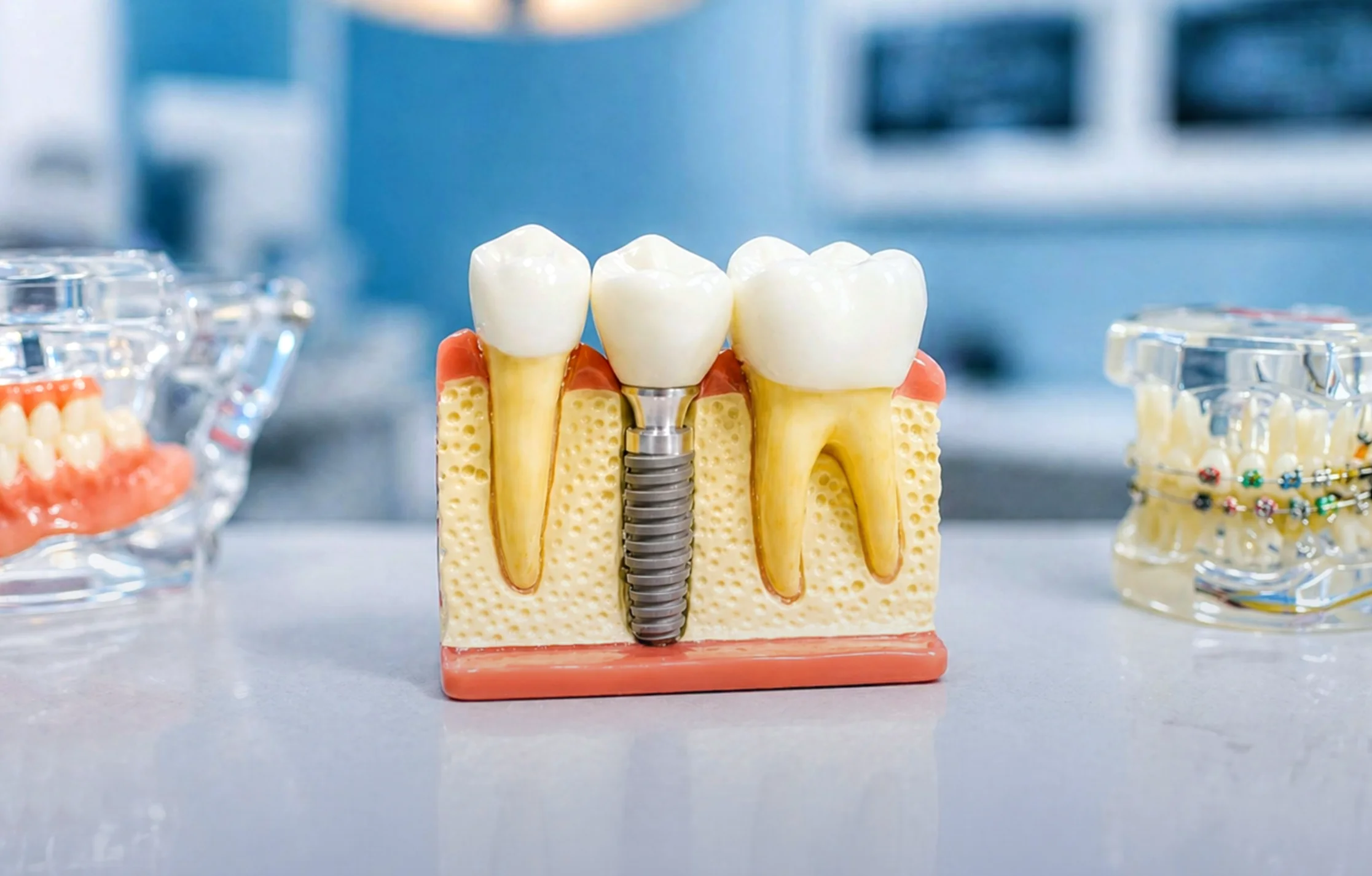
  1. Dental implant. A small post placed in the jawbone that acts as a tooth root, topped with a crown. Fixed in place and independent of neighboring teeth.
  2. Dentures (partial or complete). Removable replacements. A partial fills gaps between natural teeth, while a complete denture replaces a full arch.
  3. Bridge. A replacement tooth anchored to crowns on the natural teeth on either side of the gap. Fixed in place.

The right choice depends on your health, how many teeth are missing, the condition of your remaining teeth and bone, and your own priorities.

Dental Implants: The Closest Thing to a Natural Tooth

An implant replaces both the root and the visible tooth. After the post is placed, the bone heals around it over a period of months, and then a custom crown is attached. Because the post sits in the bone, it helps preserve bone in that spot in a way dentures and bridges don’t.

People like implants because they feel stable, stay in at night, and leave neighboring teeth untouched. Implants can also anchor a denture, helping it stay put much better than one resting on the gums alone.

Who Is a Good Candidate for Implants?

Implants tend to work well for adults who:

  • Have healthy gums, or gum disease that is treated and under control
  • Have enough jawbone, or can have bone added
  • Are in reasonably good general health
  • Don’t smoke, or are willing to quit (smoking can slow healing)
  • Are comfortable with a process that takes several months

Uncontrolled diabetes, certain medications, or past radiation to the head and neck can change whether an implant makes sense, so your health history matters. If a tooth still needs to come out, or bone has thinned, tooth extraction and bone grafting can sometimes prepare the site. Learn more about our approach to dental implants in Modesto.

Dentures: A Flexible Option for a Few Teeth or a Full Smile

Dentures remain a practical, widely used choice, especially for older family members missing several teeth or a full arch.

  • Partial dentures clip onto remaining natural teeth, filling the spaces and helping stop neighbors from drifting.
  • Complete dentures replace all the teeth on the upper or lower jaw, or both.

Dentures often suit people who aren’t implant candidates, prefer a non-surgical approach, or need to replace many teeth at once. The trade-offs: they’re removable, can feel bulky at first, and because they don’t stimulate the bone, the jaw keeps changing slowly. That’s why dentures need occasional adjustments or relining. Read more about partial and complete dentures in Modesto.

Bridges: Worth Asking About

A traditional bridge attaches a replacement tooth to crowns placed on the teeth on each side of the gap. It’s fixed, and it’s usually quicker than an implant because there’s no healing period for a post.

The main downside is that the neighboring teeth must be reshaped to hold the crowns, even if they were healthy. Cleaning under a bridge also takes extra effort, often with floss threaders or a water flosser. And because a bridge doesn’t replace the root, the bone underneath can still shrink.

If you’re curious whether a bridge fits your situation, bring it up at your consultation and ask how it compares to the options above. If a neighboring tooth already has a large filling or damage, it may need a crown anyway, and our page on adult dental crowns explains how crowns protect weakened teeth.

Care and Lifespan Over the Years

No replacement is “set it and forget it,” and results vary from person to person.

  • Implants can last many years, often decades, with good care, though the crown may eventually need replacing from normal wear. Brush and floss around them like natural teeth, since gum inflammation can threaten the bone holding the post.
  • Dentures are usually relined now and then as the gums change, and many people need a new set after several years. Remove and clean them daily, and give your gums a rest overnight unless your dentist advises otherwise.
  • Bridges often last a good number of years, depending largely on the health of the supporting teeth.

Regular dental exams and cleanings catch small issues, like a loose denture or early gum irritation, before they grow.

Questions to Think About Before Your Visit

  1. How many teeth are missing, and where?
  2. Do you prefer something fixed, or is removable fine?
  3. Can you commit to a process lasting several months?
  4. What health conditions or medications should your dentist know about?
  5. What does your insurance or Medi-Cal plan cover?

For older family members, it helps to bring an adult child or caregiver. A second set of ears makes the details easier to remember.

Replacing Teeth With Family and Kids Dental

Family and Kids Dental, at 1207 14th St, cares for kids and adults under one roof, so grandparents, parents and children can see the same team. Dr. Syed Hyder, DDS, is a general dentist with 10 years of gentle, whole-family care. He’ll look at your teeth, gums and bone, listen to your goals, and explain which options fit.

We welcome patients from Modesto, Ceres, Turlock, Riverbank, Oakdale, Salida, Empire and Keyes. We accept Medi-Cal and most major dental insurance plans, offer flexible payment options, and serve English and Spanish-speaking families. Learn more on our family dentist in Modesto, CA homepage.

Frequently Asked Questions

Is it really necessary to replace a back tooth nobody can see?
Usually, yes. Back teeth handle most of the heavy chewing. Once one is gone, nearby teeth can tilt into the space, the opposing tooth can drift toward it, and the bone in that spot slowly shrinks. Together these changes can throw off your bite and make the remaining teeth harder to keep clean. Even if appearance isn’t a concern, replacing a back tooth helps protect the rest of your mouth.

Am I too old for dental implants?
Age alone is rarely the deciding factor. Overall health, gum condition and available bone matter far more, and many older adults have implants placed successfully. Uncontrolled diabetes, heavy smoking or certain medications can affect healing, so your dentist will review your health history carefully. If implants aren’t a good fit, conventional dentures or implant-supported dentures may still be worth discussing.

How long does it take to get used to new dentures?
Most people feel comfortable within a few weeks, though it varies. At first dentures can feel bulky, speech may sound a little different, and you may notice extra saliva. Soft foods cut into small pieces, chewing on both sides at once, and reading aloud all help. Sore spots are common early on and usually need only a quick adjustment, so tell your dentist instead of putting up with them.

Can I wait a while after a tooth is pulled before deciding?
You can take some time, but try not to wait too long. Bone loss and shifting tend to begin in the months after an extraction. If you might want an implant later, ask whether bone grafting at the time of extraction makes sense, since it can help preserve the site. Discussing your options before or soon after the tooth comes out keeps more choices open.

Does Medi-Cal cover dentures or implants for adults?
Medi-Cal Dental generally covers partial and complete dentures for eligible adults when they’re medically necessary. Implants are typically covered only in limited, exceptional cases and usually need prior approval. Because coverage rules can change, please call our office with your plan details and we’ll help you understand what applies before treatment begins. We also accept most major dental insurance plans and offer payment plans.

Talk With a Family Dentist in Modesto About Your Options

If you or someone you love is living with a missing tooth, a consultation is the easiest first step. You’ll leave with a clear picture of your choices and no pressure to decide on the spot. Seeing a family dentist in Modesto who cares for every generation can make the process simpler for everyone.

Family and Kids Dental
1207 14th St, Modesto, CA 95354
Phone: (209) 422-3176

Schedule an appointment online or call our office, and our team will help you find a time that works for your family.

Family Dentist

Root Canal or Extraction? How a Family Dentist in Modesto Helps You Decide

“Can’t you just pull it?”

When a tooth is badly decayed, cracked or infected, a lot of adults ask that before the dentist has finished explaining the options. It makes sense. Pulling a tooth sounds faster and cheaper than a root canal. Sometimes it is the right call. But the choice that feels easier today can turn out to be the more complicated one a year or two later.

As a family dentist in Modesto, Dr. Syed Hyder, DDS, has this conversation with adult patients regularly. This guide covers the same ground: what each treatment involves, the honest pros and cons, how long-term costs compare, what life looks like afterward, and what to ask before you decide.

Why the Choice Comes Up

Inside every tooth is soft tissue called the pulp, which holds the nerve and blood supply. When deep decay, a crack, a leaking old filling or an injury lets bacteria reach the pulp, it can become inflamed or infected. That’s usually when people notice lingering sensitivity to hot or cold, throbbing at night, pain when chewing, or a small bump on the gum.

An infected pulp won’t heal on its own, and antibiotics alone don’t remove the source. That leaves two real solutions: clean out the inside of the tooth and keep it (a root canal), or remove the tooth (an extraction).

What a Root Canal Involves

During a root canal, the tooth is numbed, the damaged pulp is removed, and the canals inside the roots are cleaned and sealed. Many patients say it feels a lot like getting a large filling. The painful reputation mostly comes from the toothache people have beforehand, which treatment is meant to relieve.

Pros:

  • You keep your natural tooth, root and all.
  • Your bite and the position of neighboring teeth stay the same.
  • The jawbone around the tooth stays supported.
  • With good care, a treated tooth can last many years, often a lifetime.

Cons:

  • It may take more than one visit.
  • Back teeth usually need a crown afterward, which adds a step and a cost.
  • Not every tooth is a good candidate, and a small number need follow-up care later.

What an Extraction Involves

An extraction removes the whole tooth. Simple extractions are often quick, while teeth broken at the gumline or with curved roots take more work. If you may want an implant later, the dentist may recommend placing bone graft material in the socket at the same visit. Our extraction and bone grafting page explains why preserving that bone matters.

Pros:

  • The infection source is gone in one visit.
  • The upfront cost is usually lower than a root canal plus crown.
  • It’s often the best choice for a tooth that can’t be predictably saved.

Cons:

  • An empty gap has long-term consequences (more on that below).
  • Replacing the tooth often costs more than saving it would have.
  • The socket needs a few days of careful protection while it heals.

How a Family Dentist in Modesto Weighs the Options

There isn’t one right answer for every tooth. When Dr. Hyder evaluates a problem tooth, he’s typically weighing a few practical questions:

  1. Is there enough healthy tooth left? A tooth broken below the gumline may not be able to support a crown.
  2. Is it cracked into the root? A crack that runs down the root usually means the tooth can’t be saved long term.
  3. How healthy are the gums and bone? If gum disease has left a tooth loose, treating the nerve won’t fix that.
  4. Which tooth is it? Molars do most of your chewing. A wisdom tooth with nothing to chew against may not be worth saving.
  5. What are your goals and budget? Some people want to keep every natural tooth they can. Others have health, timing or financial reasons to choose differently. Both are valid.

Thinking Long Term: The Real Cost Comparison

Comparing the two on price alone leaves out what comes next.

Saving a back tooth usually means a root canal plus an adult dental crown, because molars and premolars take heavy chewing forces and a crown helps keep a treated tooth from cracking.

After an extraction, the extraction itself is often the smallest part of the bill if you replace the tooth. Common options include:

  • Dental implant: A post placed in the jawbone with a crown on top. It’s the closest thing to a natural tooth and doesn’t rely on neighboring teeth, but it involves months of healing and is often the most expensive path. Learn more about implant dentistry.
  • Bridge: A false tooth anchored to crowns on the teeth on either side, which means reshaping those neighbors.
  • Removable partial denture: Often the most budget-friendly choice, especially when several teeth are missing. See our partial and complete dentures page.

What Happens After Each Option

After a Root Canal

Most people return to normal activities the same day. Mild soreness for a few days is common and is usually managed with over-the-counter pain relievers as directed. Avoid chewing hard foods on that tooth until the final filling or crown is in place, since an unprotected treated tooth is more likely to break. After that, brush, floss and keep regular checkups as usual.

After an Extraction

The first day or two is about protecting the blood clot in the socket. That generally means no smoking, no straws and no vigorous rinsing at first, plus soft foods. Discomfort usually settles within a few days, while the gum and bone keep healing for weeks.

Over months and years, a missing tooth can lead to changes people don’t expect:

  • Neighboring teeth can tilt or drift into the gap.
  • The opposing tooth may slowly move toward the empty space.
  • The jawbone in that spot gradually shrinks, which can make a future implant harder without grafting.
  • Chewing shifts to the other side, adding wear to those teeth.

Questions to Ask Before You Decide

Bring these to your appointment:

  1. Can this tooth realistically be saved, and how long might it last?
  2. Will I need a crown, and how soon?
  3. If I choose extraction, how would you replace the tooth, and when?
  4. Should bone grafting be done at the time of extraction?
  5. What is the total estimated cost of each path, and what does my insurance cover?
  6. What happens if I wait?

That last one matters. An infected tooth usually gets worse, and waiting can turn a saveable tooth into one that has to come out.

Adult Care at Family and Kids Dental

Many families know us first for children’s care, but adults are a big part of every day here. Family and Kids Dental at 1207 14th St treats kids and adults under one roof, so parents can handle their own dental needs in the same place their children go. We see patients from Modesto, Ceres, Turlock, Riverbank, Oakdale, Salida, Empire and Keyes.

Dr. Hyder takes time to show you what he sees, explain each option plainly, and let you make the call. We accept Medi-Cal and most major dental insurance plans, offer payment plans, and serve English and Spanish-speaking patients. If cost is part of your decision, our dental payment options page is a good start, and you can read more about us as a family dentist in Modesto.

Frequently Asked Questions

Is a root canal more painful than an extraction?
Neither should be painful during treatment, because the area is numbed first. A root canal often feels similar to a long filling appointment. Mild soreness for a few days afterward is common with both. The pain people associate with root canals is usually the infection they had beforehand, and treatment is what relieves it.

How long does a tooth last after a root canal?
With a proper final restoration and good home care, a tooth treated with a root canal can last many years, and often a lifetime. The main risks are new decay, gum disease and fracture. That’s why a crown is so often recommended on back teeth, and why getting the final restoration done promptly matters.

Is it cheaper to just pull the tooth?
Upfront, an extraction usually costs less than a root canal and crown. Over time, it depends on what you do next. Replacing the tooth with an implant or bridge can cost more in total than saving it would have. Leaving the space empty avoids that cost but may lead to shifting teeth or bone loss later. Ask for the full estimated cost of each path before deciding.

Do I always need a crown after a root canal?
Not always. Molars and premolars usually need a crown because they take heavy chewing forces, and a treated tooth is more prone to cracking. Front teeth with plenty of healthy structure left may only need a filling. Your dentist will base the recommendation on how much of the tooth remains.

How soon should I decide?
You can take a short time to think it over, but it’s not wise to wait long with an infected tooth. Infection can spread, pain can return suddenly, and a tooth that’s saveable today may break down until it can’t be saved. If you have facial swelling, fever or trouble swallowing, seek care right away. Otherwise, ask your dentist what a reasonable timeline looks like for your situation.

Does Medi-Cal cover root canals or extractions for adults?
Medi-Cal Dental has covered many root canals and extractions for eligible adults, but coverage depends on the tooth, the treatment plan and sometimes prior authorization. The state has also announced changes for certain adult members starting July 1, 2027, so coverage isn’t the same for everyone. The best step is to call our office with your details. We accept Medi-Cal and most major dental insurance plans and will help you understand your coverage before treatment.

Book a Visit for a Problem Tooth

If a tooth hurts, has a crack, or was flagged at your last visit, don’t wait until the choice is made for you. An exam and X-ray will show whether the tooth can be saved, and you’ll leave knowing your options and costs. We’d be glad to be your family dentist in Modesto, for decisions like this one and for everyday care.

Family and Kids Dental
1207 14th St, Modesto, CA 95354
Phone: (209) 422-3176

Schedule an appointment online or call our office, and our team will help you find a time that works for you.

Call Us Text Us WhatsApp